
How Long Does Attic Insulation Last in Florida’s Humidity? Expert Answers for 2026
If your cooling bills keep climbing and your attic smells damp after summer storms, the short answer is this: attic insulation in Florida may last roughly 15 to years or longer, but humidity, roof leaks, pests, compression, and poor installation can cut that life down fast. How Long Does Attic Insulation Last in Florida’s Humidity? In real homes across South Florida, the answer depends less on age alone and more on moisture control, air sealing, and whether the material still performs as intended.
Homeowners in Miami-Dade, Broward, Palm Beach, and Collier counties are paying closer attention in 2026 for a few practical reasons. Florida households spent an average of about $1,900 per year on energy in recent federal estimates, and cooling is one of the biggest pieces of that load, according to Energy.gov. At the same time, high dew points, hurricane-season roof damage, and insurance-related property maintenance concerns make attic performance more than a comfort issue.
There is also a difference between physical lifespan and effective performance. Insulation can still be sitting in your attic after years and yet do a poor job controlling heat and moisture because it has settled, gotten wet, or pulled away from framing. That distinction matters when you ask, How Long Does Attic Insulation Last in Florida’s Humidity? A material may survive on paper while failing in practice.
Based on our research and field experience, Florida homeowners get better results when they compare insulation systems using building science, not slogans. Green Service Insulation is a family-owned, licensed, and insured contractor headquartered in Hollywood, Florida, with over years of experience serving South Florida and Southwest Florida. We found that the best attic decisions usually come from looking at roof condition, airflow, moisture sources, code requirements, and material fit together.
That is why this page compares spray foam, blown-in insulation, batt insulation, mineral wool, and Fi-Foil radiant barriers using performance factors such as R-value retention, air leakage control, moisture resistance, and durability. If you are trying to answer How Long Does Attic Insulation Last in Florida’s Humidity? for your own home, those four factors will tell you much more than a product brochure ever will.
How Long Does Attic Insulation Last in Florida’s Humidity?
The most honest answer is a range, not a single number. In Florida attics, many loose-fill systems last around 15 to years, while well-installed spray foam can last 20 to years or more. But when homeowners ask How Long Does Attic Insulation Last in Florida’s Humidity? we recommend separating lifespan into four measures: R-value retention, air-sealing performance, moisture resistance, and physical stability. A product can score well in one category and poorly in another.
Florida humidity by itself does not automatically destroy insulation. Based on our analysis, the bigger threats are bulk water intrusion, condensation, air leakage, ultraviolet exposure near roof vents, settling, and repeated temperature cycling. Attics in summer can exceed 120°F to 140°F depending on roof color and ventilation, and those swings matter over time, especially when moisture is also present.
| Material | Typical service life | Main limits in Florida |
| Fiberglass batts | 15-25 years | Compression, gaps, moisture, misalignment |
| Blown-in fiberglass | 15-30 years | Settling, wind washing, moisture exposure |
| Blown-in cellulose | 15-30 years | Moisture uptake, settling, contamination |
| Open-cell spray foam | 20-40+ years | Installation quality, roof leaks, substrate moisture |
| Closed-cell spray foam | 20-50+ years | Cost, substrate prep, hidden leak risk |
| Mineral wool | 20-40 years | Air leakage around it, roof leaks, fit issues |
| Fi-Foil radiant barrier | 10-25+ years | Dust buildup, tears, poor attachment |
We found that homeowners make better decisions when they use a simple five-step check instead of guessing by age alone:
- Identify the material in the attic.
- Inspect condition for settling, staining, odors, or pulled-away sections.
- Check moisture sources such as roof leaks, duct sweating, and plumbing penetrations.
- Measure depth or coverage at several points, not just one.
- Arrange a professional assessment if performance symptoms match visible damage.
That method gives you a more useful answer to How Long Does Attic Insulation Last in Florida’s Humidity? than an age estimate alone. In our experience, a 12-year-old attic with leaks can perform worse than a dry, well-installed 25-year-old attic. So when you ask How Long Does Attic Insulation Last in Florida’s Humidity?, conditions matter more than the calendar.
Schedule a free on-site assessment
What Florida Humidity Does to Attic Insulation
Warm, moisture-laden air enters attics through small openings you rarely notice from inside the house: ceiling penetrations, recessed lights, duct openings, plumbing chases, bath fan housings, and attic access panels. When that air reaches cooler surfaces, condensation can form. According to Building Science Corporation and Energy.gov, air leakage and insulation have to be treated as one system because moving air carries moisture far more effectively than simple vapor diffusion in many assemblies.
Florida-specific conditions make this worse. Summer outdoor dew points commonly climb above 70°F, air conditioners run for long hours, and wind-driven rain during tropical systems can exploit small roof weaknesses. In coastal areas near Miami-Dade, Broward, and Palm Beach counties, salt exposure can also accelerate wear on metal components around vents, fasteners, and roof assemblies, which indirectly raises the risk of moisture intrusion.
Damp fiberglass or cellulose does not always look dramatic at first. It may simply become heavier, compressed, and less effective. The EPA warns that moisture can support mold growth on contaminated surfaces such as dust, paper facings, and organic debris, even if the insulation itself is not the food source. Spray foam often handles humid conditions better, but it can still fail if it is installed over wet roof decking or if an existing leak is left unresolved.
We recommend thinking through a real-world scenario. A homeowner in Broward County notices a 22% jump in summer cooling costs and a musty odor after a roof leak around a vent boot. The temptation is to replace the stained insulation right away. But if the roof defect stays in place, new insulation only hides the problem for a few months. That is why How Long Does Attic Insulation Last in Florida’s Humidity? cannot be answered without asking where moisture is coming from. Based on our research, How Long Does Attic Insulation Last in Florida’s Humidity? is usually a moisture-control question as much as an insulation question. In many homes, How Long Does Attic Insulation Last in Florida’s Humidity? comes down to whether humid air and rainwater are being kept out of the assembly in the first place.
Signs Your Attic Insulation Needs Replacement
The clearest warning signs are visible. Look for dark staining, wet or matted material, sagging batts, uneven blown-in coverage, exposed ceiling areas, pest nesting, mold-like growth, strong odors, and insulation pulled away from the roofline. If you see any of those near roof penetrations, soffits, or the attic hatch, do not assume the rest of the attic is fine. Damage tends to cluster around leakage paths.
Performance symptoms matter just as much. Rooms that stay hot by late afternoon, frequent AC cycling, high indoor humidity, condensation on ducts, and rising utility bills despite normal thermostat settings can all point to attic problems. According to Energy.gov, homeowners can reduce heating and cooling costs by an average of about 15% through air sealing and insulation improvements in many cases, but that only happens when the system is intact and properly installed.
Still, one hot room does not prove insulation failure. We analyzed many comfort complaints where the main issue was actually duct leakage, poor airflow, solar gain through west-facing glass, air-handler defects, or roof assembly design. The attic may be part of the problem, but not the only cause. That is why a safe and structured inspection matters.
Use this homeowner checklist:
- Look from the attic entry first without disturbing material.
- Photograph problem areas with time-stamped images.
- Avoid stepping between joists; ceiling drywall will not support your weight.
- Measure loose-fill depth at several points, including center spans and edges.
- Watch critical areas near eaves, recessed lights, attic hatches, and duct penetrations.
- Call a qualified professional when electrical, mold, or structural concerns appear.
Those edge areas often matter more than average depth alone because heat and moisture commonly move through gaps, not through the thickest parts of the attic. If you have been asking How Long Does Attic Insulation Last in Florida’s Humidity?, your answer may already be visible in those weak spots. In our experience, How Long Does Attic Insulation Last in Florida’s Humidity? is often best diagnosed by coverage consistency, not just age. And if musty smells and compressed insulation show up together, How Long Does Attic Insulation Last in Florida’s Humidity? becomes a replacement discussion, not a waiting game.
How Each Insulation Type Performs in a Hot, Humid Attic
Open-cell spray foam and closed-cell spray foam both air-seal far better than loose-fill products, but they are not the same material. Open-cell foam has a lighter structure and can work well when the assembly is designed for it. Closed-cell foam delivers a higher R-value per inch, often around R-6 to R-7 per inch, and offers greater resistance to moisture movement, but it usually costs more and demands careful substrate preparation.
Blown-in insulation, whether fiberglass or cellulose, remains common in Florida because it can cover large attic floors efficiently. Fiberglass does not absorb water the same way cellulose can, but both materials can lose effective performance when moisture, settling, or wind washing reduce coverage. We recommend checking that soffit ventilation paths stay open with baffles; otherwise, insulation can block intake airflow and create heat or moisture problems.
Batt insulation still makes sense in accessible cavities and certain retrofit situations. The problem is not the product itself but the installation quality. Even small gaps or compression can cut real-world performance far below labeled values. Mineral wool stands out for fire resistance, pest resistance, and low moisture absorption, but it still cannot fix a leaky roof or an unsealed ceiling bypass. Fi-Foil radiant barrier insulation works differently from thermal insulation because it reduces radiant heat transfer from the roof deck; it does not replace the need for code-appropriate insulation levels.
Dusty foil surfaces and poor attachment can reduce radiant barrier effectiveness over time. That is why we recommend choosing materials based on roof assembly, humidity control, access, existing damage, budget, and Florida Energy Code requirements, not just a brochure claim. When clients ask How Long Does Attic Insulation Last in Florida’s Humidity?, we compare how each material handles moisture, airflow, and installation risk. Based on our analysis, How Long Does Attic Insulation Last in Florida’s Humidity? varies because each product fails differently. For many homes, the right answer to How Long Does Attic Insulation Last in Florida’s Humidity? starts with matching the insulation type to the attic design rather than picking the highest advertised R-value.
Florida Energy Code, Ventilation, and Air-Sealing Requirements
The Florida Building Code and Florida Energy Code affect more than the amount of insulation in your attic. They influence ceiling assemblies, air barriers, duct systems, insulation installation details, and whether ventilation pathways remain open and continuous. Homeowners can review current requirements through the Florida Building Commission, which publishes code resources and updates. As of 2026, code discussions often come up during insulation upgrades because homes need both proper thermal resistance and proper detailing.
Insulation and ventilation do different jobs. Insulation slows heat transfer. Ventilation helps manage attic heat and moisture when it is designed correctly. Trouble starts when conditioned indoor air leaks into the attic or when soffit channels are blocked by loose-fill insulation. Soffit vents, ridge vents, gable vents, wind baffles, attic access doors, recessed lighting, and duct penetrations all affect whether the attic behaves as intended.
Code compliance alone does not guarantee comfort. We found that homes can technically meet insulation targets yet still feel uneven because of gaps, compression, thermal bridges, and unsealed bypasses. A home with recessed can lights leaking air into the attic can still experience condensation and high cooling runtime even if the insulation depth looks acceptable. The Department of Energy also notes that air sealing can be one of the most cost-effective ways to improve efficiency before or with added insulation.
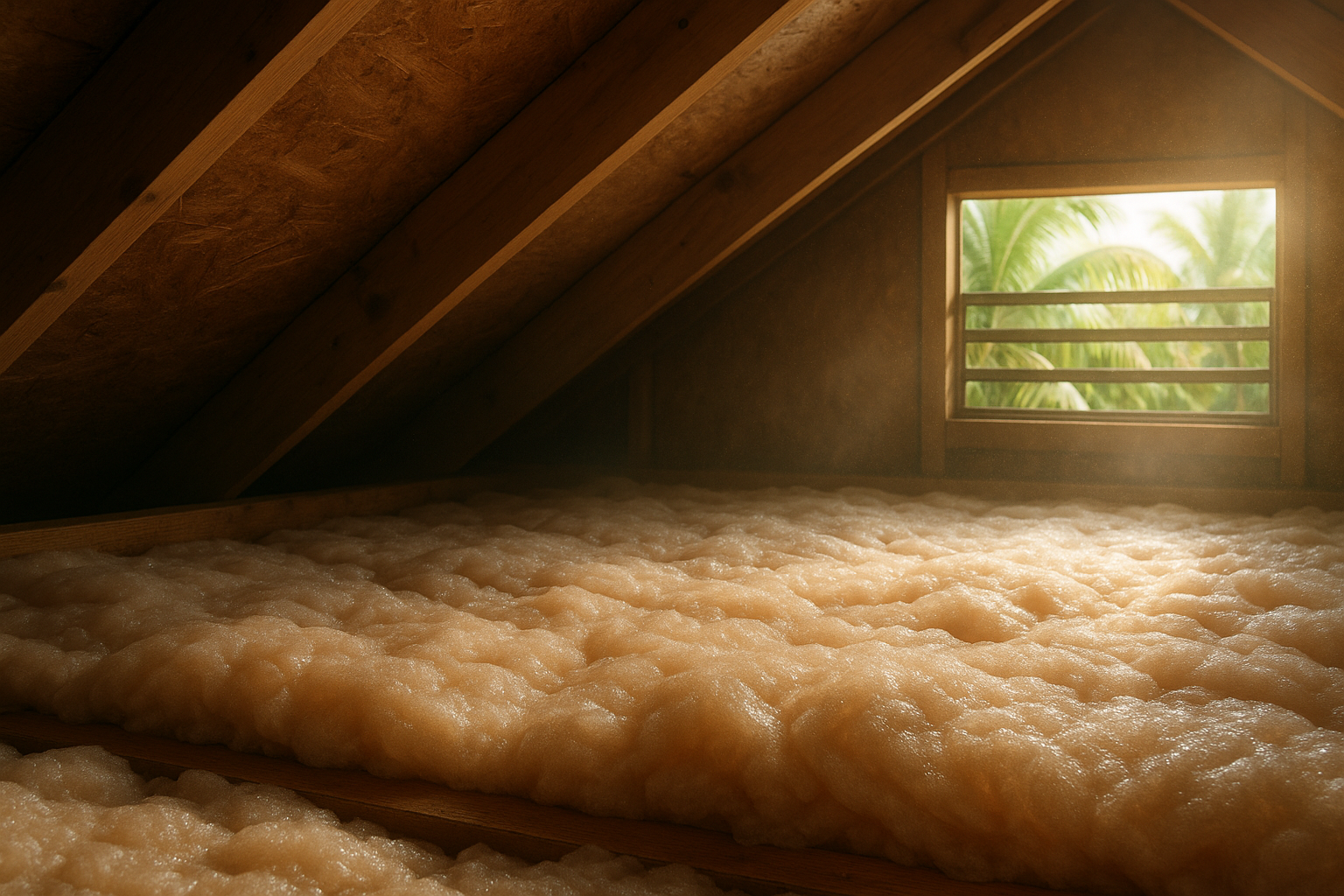
A practical inspection sequence works best:
- Confirm roof condition and rule out active leaks.
- Identify air leaks at hatches, lights, chases, and top plates.
- Verify ventilation paths from soffits to higher exhaust points.
- Measure insulation coverage and compare weak areas.
- Decide between topping up or full replacement based on damage and contamination.
That sequence gives a better answer to How Long Does Attic Insulation Last in Florida’s Humidity? than a sales estimate that skips diagnostics. In our experience, How Long Does Attic Insulation Last in Florida’s Humidity? is closely tied to whether the air barrier and venting details were handled correctly from day one. For that reason, How Long Does Attic Insulation Last in Florida’s Humidity? is also partly a code-and-installation question.
When to Remove Attic Insulation Instead of Adding More
Some attics should be topped off. Others should be cleaned out first. Professional removal is often justified when insulation has been affected by sewage or flood contamination, extensive mold growth, rodent infestation, major roof leaks, fire damage, severe compression, or hazardous debris. In those cases, adding fresh material on top can trap moisture, hide electrical issues, block ventilation channels, and make future inspection harder.
That matters because contamination changes the project from an energy upgrade into a health and building-condition issue. The EPA has long advised addressing moisture and contamination at the source rather than covering it up. If insulation contains animal waste, visible mold, or unknown legacy debris, disturbing it without protective controls can spread particles through the home.
A simple decision framework helps:
- Top-up insulation may work when the existing material is dry, reasonably clean, and only moderately underperforming.
- Removal and replacement is often smarter when there is contamination, chronic moisture, major settling, or extensive physical damage.
- Further diagnosis first is needed when you are not sure whether comfort issues come from insulation, ducts, or air leakage.
Homeowners should not disturb suspected mold, rodent waste, or unknown older materials on their own. Professionals should use containment, protective equipment, and proper disposal procedures. We recommend asking exactly how waste will be bagged, removed, and documented. Green Service Insulation offers professional insulation removal and replacement for homes that need a fresh start, especially after leaks or contamination, without promising a one-size-fits-all outcome.
When people ask How Long Does Attic Insulation Last in Florida’s Humidity?, they often mean, “Can I save what is already there?” Sometimes yes. Sometimes no. Based on our research, How Long Does Attic Insulation Last in Florida’s Humidity? becomes a removal question when the material is no longer sanitary, stable, or dry. In those cases, How Long Does Attic Insulation Last in Florida’s Humidity? is less useful than asking whether the old insulation should still be in the attic at all.
How Much Does Attic Insulation Replacement Cost in South Florida?
Costs vary widely in Florida, so broad planning ranges are more honest than one national average. The biggest cost drivers are attic square footage, insulation type, target R-value, removal and disposal, access difficulty, roof geometry, air sealing, duct work, electrical obstacles, ventilation corrections, and moisture remediation. A small, open attic with clean existing material will price very differently from a large, low-clearance attic with contamination and active leak history.
As a rough planning guide, blown-in insulation is often the most budget-friendly for open attic floors, while batt insulation can be cost-effective in straightforward accessible areas. Open-cell spray foam generally costs more up front because installation is specialized, and closed-cell spray foam is usually higher still due to material density and application demands. Mineral wool often lands above standard fiberglass options, and Fi-Foil radiant barriers add a different cost category because they complement rather than replace core thermal insulation.
We found that homeowners get better bids when they compare written scopes line by line. Ask whether the price includes old insulation removal, disposal fees, attic prep, air sealing, baffles, hatch treatment, photographs, and post-install documentation. That can explain why two proposals for the same square footage differ by 20% to 40%.
Better insulation may reduce cooling demand and improve comfort, but no contractor should promise a fixed utility-bill reduction. HVAC age, thermostat settings, windows, ducts, occupancy, and solar exposure all matter. For 2026, homeowners should also review financial options such as possible FPL rebate eligibility and the ENERGY STAR federal tax credit guidance, which explains the current 30% federal tax credit for qualifying improvements when project and taxpayer requirements are met.
That cost conversation also affects How Long Does Attic Insulation Last in Florida’s Humidity?, because lower-cost work that skips moisture correction can fail early. In our experience, How Long Does Attic Insulation Last in Florida’s Humidity? is partly a budgeting question: do the job once with the right prep, or pay twice. If you want a realistic answer to How Long Does Attic Insulation Last in Florida’s Humidity?, compare total project quality, not just price per square foot.
How to Check Whether New Attic Insulation Is Working
Once new insulation is installed, you should track results instead of assuming the job is done. A simple 30-, 90-, and 180-day evaluation plan helps you see whether comfort and moisture conditions are actually improving. Start with the rooms that used to be hottest or muggiest, because those are the best test zones.
At days, check indoor temperature consistency, note whether the thermostat runs less often during similar weather, and inspect for duct condensation or new odors. At days, compare utility bills against similar-season usage while accounting for outdoor temperature changes. At days, evaluate comfort through a different weather period and inspect the attic again for settling, displaced material, or moisture signs. According to the ENERGY STAR program, good records make it easier to judge whether an efficiency upgrade delivered practical value.
Use a calibrated hygrometer and record indoor relative humidity in several rooms. Many homes feel comfortable around 40% to 60% relative humidity, though there is no one perfect number for every house and season. We recommend logging readings at the same time each day for at least two weeks. If humidity remains high, insulation may not be the only issue.
Professional verification can reveal what your eyes miss. Infrared imaging, blower-door testing, duct testing, and attic moisture measurements can identify hidden bypasses or installation gaps. We analyzed a Broward County home where new attic insulation helped, but the real comfort problem was a combination of leaking ducts and unsealed recessed lights. Until those were fixed, one bedroom still ran 4°F warmer than the rest of the house.
Request documentation that includes material type, installed R-value, coverage depth, air-sealing work, ventilation changes, product information, and before-and-after photos. That record helps with maintenance, future bids, and insurance or rebate questions. It also gives you a more practical way to answer How Long Does Attic Insulation Last in Florida’s Humidity? over time. Rather than guessing, you can track performance. And that makes How Long Does Attic Insulation Last in Florida’s Humidity? a measurable question, not just a marketing claim. Over the long run, How Long Does Attic Insulation Last in Florida’s Humidity? is best judged by comfort, humidity control, and stable performance data.
A Florida Homeowner’s Action Plan for and Beyond
If your attic has not been evaluated in years, the smartest next step is not picking a material first. It is understanding the attic you already have. Based on our analysis, homeowners in Miami-Dade County, Broward County, Palm Beach County, and Collier County get better long-term outcomes when they follow a short, disciplined process before approving work.
- Inspect from a safe location near the attic entry and take photos.
- Repair roof or plumbing leaks first; insulation should never hide active moisture problems.
- Document comfort and humidity symptoms such as hot rooms, odors, condensation, and high bills.
- Obtain a professional on-site evaluation that looks at air leakage, ventilation, ducts, and insulation together.
- Compare written scopes instead of choosing by material name alone.
When you speak with contractors, ask whether they are licensed and insured, how they address air leakage, how they protect soffit ventilation, what happens to damaged insulation, and which Florida Energy Code provisions apply to your project. Those questions matter because insulation in 2026 is not just about comfort. It connects to energy efficiency, indoor humidity control, hurricane-season resilience, insurance discussions, sustainability, and long-term operating costs.
Green Service Insulation serves South Florida and Southwest Florida from 2844 Stirling Rd Suite #B, Hollywood, FL 33020. You can reach the team at 754-239-3223, email info@greenserviceinsulation.com, or visit https://greenserviceinsulation.com/. If you want to compare services, you can also review their attic insulation service page.
We recommend asking for a free on-site estimate so the attic can be assessed for moisture, air leakage, ventilation, and material condition before any recommendation is made. If you are still weighing How Long Does Attic Insulation Last in Florida’s Humidity?, remember the key point: insulation lasts longest when the roof stays dry, the air barrier is tight, and the material matches the assembly. In our experience, How Long Does Attic Insulation Last in Florida’s Humidity? is the right question only when it is followed by “What is shortening its life right now?” Ask that, and you will make a much better decision. For most homes, How Long Does Attic Insulation Last in Florida’s Humidity? is really a question about protecting the whole attic system, not just replacing one product.
This content is intended for general informational purposes only and should not be considered a substitute for professional evaluation or engineering advice. Results may vary based on building structure and environmental conditions.
Talk to a Florida insulation expert
Key Takeaways
- Attic insulation in Florida often lasts about to years, while some spray foam systems can last to years or more, but moisture, air leaks, settling, pests, and poor installation usually matter more than age alone.
- Do not judge insulation by depth only; check roof condition, attic air leaks, ventilation paths, odors, staining, duct condensation, and coverage gaps near hatches, eaves, lights, and penetrations.
- Replace insulation after contamination, major leaks, fire damage, severe compression, or pest activity; topping off wet or dirty material can trap problems and make future repairs harder.
- In 2026, compare written scopes carefully and verify code details, rebate rules, and tax-credit eligibility directly with FPL, ENERGY STAR, and the Florida Building Commission before approving work.
- Your best next step is a safe visual check followed by a professional on-site evaluation that considers insulation, air sealing, ventilation, ducts, and moisture as one connected attic system.
Frequently Asked Questions
Should you replace attic insulation after a roof leak?
Yes. In Florida, wet insulation often loses performance quickly, especially fiberglass and cellulose. If the material stayed damp, smells musty, shows staining, or sits below a roof or plumbing leak, it should be professionally evaluated before you add anything on top.
Does attic insulation wear out in Florida faster than in dry climates?
Not always. Based on our analysis, many systems physically remain in place for to years or more, but useful performance can drop much sooner if there is moisture, settling, air leakage, pests, or poor installation. That is why the better question is often How Long Does Attic Insulation Last in Florida’s Humidity? under your roof conditions, not under ideal lab conditions.
How long does spray foam insulation last in a Florida attic?
Spray foam can last to years or longer when it is installed correctly over dry materials and the roof assembly stays sound. It can still fail early if there are hidden leaks, poor substrate prep, shrinkage, or code-related installation mistakes.
Will adding more insulation fix a hot upstairs room?
No. Ventilation and insulation do different jobs. Insulation slows heat transfer, while ventilation helps manage attic heat and moisture; if vents are blocked or air leaks from the house into the attic, adding more insulation alone may not fix comfort or humidity problems.
What R-value should attic insulation have in Florida?
Many Florida homes target attic insulation around code-appropriate levels, but the right amount depends on the assembly, existing insulation, and installation quality. The Florida Building Commission and a qualified insulation contractor can help you verify what applies to your home in 2026.
When should old attic insulation be removed instead of topped off?
Homeowners should avoid disturbing insulation that may contain rodent waste, mold, or unknown legacy materials. Professional removal is often justified after sewage contamination, major roof leaks, fire damage, heavy pest activity, or severe compression that leaves the insulation ineffective.


